The value of a business depends on its growth prospects, profitability, cash conversion and the degree to which that future cash flow is at risk
o One of the main risks for small businesses is their reliance upon key personnel, particularly the owner, who know and do things that no-one else knows or can do
o This risk is present even if you have no plans to sell the business. If you the owner or one of your key staff are unable to work for an extended period what happens to your business?
o Systemisation is the process by which the processes of the business are documented and standardised and reliance on any one individual is removed
o This process also makes a business scalable; the processes can be replicated, additional staff can be selected and trained and the business can grow beyond the constraints of any one person
How can a business be systemised?
- Document all your processes. Start by asking all your staff (including you) what they spend their time doing and build up a diagram of the different flows of work from the start (say a customer enquiry) to the end (say an invoice paid)
o Post-it notes are a good way to do this. Use different colours for different people or departments and put a different task on each note. Record key dimensions on each task – how many times, how often, how long it takes. Record problems or issues with the task. Organise the notes into sequences of tasks (processes)
o Turn the hierarchy and sequence of notes into your draft written operating manual
- Identify where only one person has the skills to carry out a particular task and examine ways to enable more people to do this
o Delegation and recruitment
o Training
o Cross-skilling, so that people can turn their hand to multiple roles
o Altering the task so that it becomes less specialised
- Look for opportunities to improve processes
o Complexity that has arisen for no good reason over time
o Bottlenecks
o Different ways of carrying out what is essentially the same task
o Specialised resources being used for mundane tasks
- Automate where this is practical
o Streamline and speed processes up using computers and the internet
o Look for opportunities to provide self-service – this reduces cost and improves customer service
- Finalise and issue the operating manual
o Institute regular audits to ensure the manual and the reality match
- Starting with you, the owner, develop a succession plan
o Named individuals selected or recruited to replace the people above them
o The appropriate development plans in place for these individuals
See how my services could help your business.
See how my services could make your business worth more
Want to see videos of my seminars for business owners?
Wednesday, 22 September 2010


Wednesday, 15 September 2010
Improving productivity
What is meant by “productivity”?
- Productivity is a measure of output for some measure of input
- Productivity has huge impact on profitability as shown in the table

- This approach applies to services as well as products
How can productivity be improved?
- Decide what it is you produce (the output) – this may not be obvious in a service business
- Identify the main costs or resources utilised in production (the inputs)
- Define your productivity measure(s) – in the above table it is labour hours/item
- Monitor productivity over time and between different employees or resources
- If the main productivity factor is labour then improvements can be made in training, supervision, communication, standardisation, documentation, tools, systems or support
- For non-labour measures examine product or process design
See how my services could help your business.
See how my services could make your business worth more
Want to see videos of my seminars for business owners?
- Productivity is a measure of output for some measure of input
- Maintenance visits per hour of direct labour
- Cakes sold per hour of shop assistant labour
- Boxes produced per square metre of steel
- Helpdesk calls closed per man-month
- For your business you can choose whatever measures are most useful
- Productivity has huge impact on profitability as shown in the table
- The company has 8,000 hours per year of productive labour. The budget is based on these hours producing 100 items which results in a 10% profit.

- A 10% improvement in productivity (each person on average producing 10% more in a given period) results in a doubling of profit
- A 10% deterioration in productivity results in no profit being made at all
- This approach applies to services as well as products
How can productivity be improved?
- Decide what it is you produce (the output) – this may not be obvious in a service business
- Identify the main costs or resources utilised in production (the inputs)
- Define your productivity measure(s) – in the above table it is labour hours/item
- Monitor productivity over time and between different employees or resources
- If the main productivity factor is labour then improvements can be made in training, supervision, communication, standardisation, documentation, tools, systems or support
- For non-labour measures examine product or process design
Monday, 6 September 2010
Market triggers
What are market triggers?
- Most products and services have some kind of event that triggers the customer need
- These triggers may be seasonal (school uniform, umbrellas), calendar-driven (payroll, VAT returns) or ad-hoc (marriage, moving house)
Why should you understand your market triggers?
- Understanding your market triggers will help you to position your product or service where it is most likely to catch the customer at the right time or place
o If you run a carpet cleaning company then demand for your services might be triggered by someone moving into a new home – so post leaflets through the doors of houses with “sold” signs
o If you print business cards and stationary then demand for your services might be triggered by someone setting up a new company – so subscribe to a company registration data service and send start-ups a brochure
- Understanding the customer motivation will help you best meet their needs and so improve sales conversion rate
o Make it part of scripts and qualification to ask why the prospect is looking for your product or service
- It will help you cross-sell or up-sell other services related to the trigger
o Someone who gets divorced may well need a new will
o Someone who hires a lot of new staff may well need employment policies
- It will suggest related complementary services and so which strategic alliances would be beneficial to you
o Solicitors will form alliances with estate agents to get access to conveyancing work
See how my services could help your business.
See how my services could make your business worth more
Want to see videos of my seminars for business owners?
- Most products and services have some kind of event that triggers the customer need
- These triggers may be seasonal (school uniform, umbrellas), calendar-driven (payroll, VAT returns) or ad-hoc (marriage, moving house)
Why should you understand your market triggers?
- Understanding your market triggers will help you to position your product or service where it is most likely to catch the customer at the right time or place
o If you run a carpet cleaning company then demand for your services might be triggered by someone moving into a new home – so post leaflets through the doors of houses with “sold” signs
o If you print business cards and stationary then demand for your services might be triggered by someone setting up a new company – so subscribe to a company registration data service and send start-ups a brochure
- Understanding the customer motivation will help you best meet their needs and so improve sales conversion rate
o Make it part of scripts and qualification to ask why the prospect is looking for your product or service
- It will help you cross-sell or up-sell other services related to the trigger
o Someone who gets divorced may well need a new will
o Someone who hires a lot of new staff may well need employment policies
- It will suggest related complementary services and so which strategic alliances would be beneficial to you
o Solicitors will form alliances with estate agents to get access to conveyancing work
See how my services could help your business.
See how my services could make your business worth more
Want to see videos of my seminars for business owners?
Tuesday, 24 August 2010
A big sales technique for small businesses
- Consultative selling, or solutions selling , is a technique used by big companies for complex sales. However, it can be used by SMEs for business-to-business (B2B) or even business-to-consumer (B2C) selling. The essence is to go beyond the stated requirement to understand your prospects’ needs and explain how your product or service meets those needs better than anyone else’s.
Preparation:
- Research on the customer (for B2B - turnover, growth, products, stated aims, stated strategies, culture and strengths. For B2C – the benefits your various customer types are looking for);
- Research on the market (emerging trends, main players, size, growing/shrinking, macro-economic factors eg is the market driven by the housing market or unemployment);
Set the scene:
- For planned meetings send an agenda/have a pre-meeting telephone call that sets the expectation that you are interested in how your product or service can help the prospect achieve their aims – you are not turning up to talk about features or technology
- For unplanned (eg in a shop) make sure you have a script that engages the prospect in a discussion about their needs
The discussion:
- For B2B, set out to understand the following things:
o What the company produces
o How many/how much they produce
o What is important to their customers
o What is their USP?
o How do they get the best from their staff?
o What are the top three challenges they are facing?
- For B2C, set out to understand the experience they are seeking
o In a shoe shop, don’t ask “Can I help you?” ask “Are you looking for shoes with a special event in mind?”
o If someone rings about a new carpet ask them “What does the room feel like?” or “What atmosphere are you trying to create?”
- Explore with open questions (that require a descriptive answer) and confirm your understanding with closed questions (that can be answered Yes or No)
- Listen, listen, listen
- Explain to them how your product or service helps them achieve this
o Point by point match benefit to need
o Use their own language
o Don’t assume they will recognise all the benefits you are offering without you telling them
More business advice for business owners.
How do you value your business?
Want to see videos of my seminars for business owners?
Preparation:
- Research on the customer (for B2B - turnover, growth, products, stated aims, stated strategies, culture and strengths. For B2C – the benefits your various customer types are looking for);
- Research on the market (emerging trends, main players, size, growing/shrinking, macro-economic factors eg is the market driven by the housing market or unemployment);
Set the scene:
- For planned meetings send an agenda/have a pre-meeting telephone call that sets the expectation that you are interested in how your product or service can help the prospect achieve their aims – you are not turning up to talk about features or technology
- For unplanned (eg in a shop) make sure you have a script that engages the prospect in a discussion about their needs
The discussion:
- For B2B, set out to understand the following things:
o What the company produces
o How many/how much they produce
o What is important to their customers
o What is their USP?
o How do they get the best from their staff?
o What are the top three challenges they are facing?
- For B2C, set out to understand the experience they are seeking
o In a shoe shop, don’t ask “Can I help you?” ask “Are you looking for shoes with a special event in mind?”
o If someone rings about a new carpet ask them “What does the room feel like?” or “What atmosphere are you trying to create?”
- Explore with open questions (that require a descriptive answer) and confirm your understanding with closed questions (that can be answered Yes or No)
- Listen, listen, listen
- Explain to them how your product or service helps them achieve this
o Point by point match benefit to need
o Use their own language
o Don’t assume they will recognise all the benefits you are offering without you telling them
More business advice for business owners.
How do you value your business?
Want to see videos of my seminars for business owners?
Monday, 16 August 2010
Why qualifying sales will help sales grow
Why do you need to qualify sales leads?
- The process which takes a lead through to a sale (the conversion process) can consume a lot of resources, particularly for complex sales
- This process is much more productive (that is, has a higher conversion rate and uses less resource) if those leads which are likely to be low value and/or unlikely to result in a sale are screened out earlier in the process
- If the conversion process has very low marginal costs (eg an online shop) then the need for qualification is correspondingly lower
What factors can be used to qualify sales leads?
- The factors can vary widely according to the industry you are in but could include:
o Are you talking to the decision-maker and budget-holder?
o Are they in your target market and the right type and size of customer?
o Do they have the funds or budget to buy your product?
o Do they have the compelling need, commitment and motivation to buy now?
o Can you provide what they need without stretching your product, credibility or resources?
o Do you have all the necessary pre-qualifications (policies, accreditations, size and stability)?
o Is there an incumbent or preferred supplier who is almost certain to win the business?
How are leads qualified?
- Qualification should be part of your sales process
o It should also be built into your marketing
- It could take place at a single point or you could have several stages of qualification
- The criteria for qualification (taken, for example, from the above list) should be recorded against each lead in your sales management system
- The conversion process results (wins and losses) should feed back into the qualification process
o A low conversion rate may well indicate poor qualification
More business advice for business owners.
How do you value your business?
Want to see videos of my seminars for business owners?
- The process which takes a lead through to a sale (the conversion process) can consume a lot of resources, particularly for complex sales
- This process is much more productive (that is, has a higher conversion rate and uses less resource) if those leads which are likely to be low value and/or unlikely to result in a sale are screened out earlier in the process
- If the conversion process has very low marginal costs (eg an online shop) then the need for qualification is correspondingly lower
What factors can be used to qualify sales leads?
- The factors can vary widely according to the industry you are in but could include:
o Are you talking to the decision-maker and budget-holder?
o Are they in your target market and the right type and size of customer?
o Do they have the funds or budget to buy your product?
o Do they have the compelling need, commitment and motivation to buy now?
o Can you provide what they need without stretching your product, credibility or resources?
o Do you have all the necessary pre-qualifications (policies, accreditations, size and stability)?
o Is there an incumbent or preferred supplier who is almost certain to win the business?
How are leads qualified?
- Qualification should be part of your sales process
o It should also be built into your marketing
- It could take place at a single point or you could have several stages of qualification
- The criteria for qualification (taken, for example, from the above list) should be recorded against each lead in your sales management system
- The conversion process results (wins and losses) should feed back into the qualification process
o A low conversion rate may well indicate poor qualification
More business advice for business owners.
How do you value your business?
Want to see videos of my seminars for business owners?
Tuesday, 10 August 2010
Why do so many small businesses fail?
Why do so many small businesses fail?
This topic generated over 50 comments on a LinkedIn forum recently. This counts as a furore in the restrained atmosphere of LinkedIn Groups.
Comments came from a range of business owners, with perhaps a preponderance of those who advise other businesses. Whilst this skewed the comments made it also ensured that there was considerable experience of the reasons why UK SMEs survive or fail.
I counted up the reasons put forward – a completely unscientific analysis of a self-selecting group but interesting nevertheless. The reasons put forward were:
1. Owner's attitude/mental strength/direction/native ability/intelligence (8 mentions)
2. Business management knowledge and willingness to take advice (7 mentions)
3. Sales ability (6 mentions)
4. Financial understanding and control, particularly of cash flow (6 mentions)
5. USP/great idea or product, effective market research (5 mentions)
6. Business planning (3 mentions)
Also mentioned were: Customer understanding, luck, banks, pricing and contracts.
Not the ranking I would have come up with at the start I must confess. It prompts the question: If this ranking is reflective of anything like the actual reasons, what interventions are actually likely to be most effective?
Postscript: Whilst preparing this blog I met the owner of a design and branding company who is in his tenth year of business and expecting to turnover £1.5m this year. He and his partner have been using the latest of a series of advisors for the last 9 months - a series which started with a mentor when they set up the business. We talked about their plans to take on a shared FD shortly - not to control the finances but to raise their strategic game.
Perhaps businesses that are smart enough to know when they need advice and are willing to invest in it stand a better chance of survival.
More business advice for business owners.
How do you value your business?
Want to see videos of my seminars for business owners?
This topic generated over 50 comments on a LinkedIn forum recently. This counts as a furore in the restrained atmosphere of LinkedIn Groups.
Comments came from a range of business owners, with perhaps a preponderance of those who advise other businesses. Whilst this skewed the comments made it also ensured that there was considerable experience of the reasons why UK SMEs survive or fail.
I counted up the reasons put forward – a completely unscientific analysis of a self-selecting group but interesting nevertheless. The reasons put forward were:
1. Owner's attitude/mental strength/direction/native ability/intelligence (8 mentions)
2. Business management knowledge and willingness to take advice (7 mentions)
3. Sales ability (6 mentions)
4. Financial understanding and control, particularly of cash flow (6 mentions)
5. USP/great idea or product, effective market research (5 mentions)
6. Business planning (3 mentions)
Also mentioned were: Customer understanding, luck, banks, pricing and contracts.
Not the ranking I would have come up with at the start I must confess. It prompts the question: If this ranking is reflective of anything like the actual reasons, what interventions are actually likely to be most effective?
Postscript: Whilst preparing this blog I met the owner of a design and branding company who is in his tenth year of business and expecting to turnover £1.5m this year. He and his partner have been using the latest of a series of advisors for the last 9 months - a series which started with a mentor when they set up the business. We talked about their plans to take on a shared FD shortly - not to control the finances but to raise their strategic game.
Perhaps businesses that are smart enough to know when they need advice and are willing to invest in it stand a better chance of survival.
More business advice for business owners.
How do you value your business?
Want to see videos of my seminars for business owners?
Monday, 26 July 2010
Customer benefits and their costs
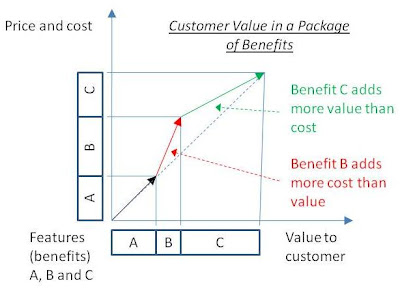
A customer buys a package of benefits when they buy your product or service
- Some of these benefits are more important than others to your customer – some they may not want or value at all, some are critical and some they may not even realise they get. This will be different for each customer
- Some of these benefits cost you more than others to provide – some cost you a lot and some are free – or may even reduce your costs
- If you understand the relative value and cost then this allows you to make adjustments to your product, pricing and proposition so that you optimise revenue and margin
o This is the basis of the low-cost airline model. The benefits that were removed were valued less by passengers than the price reduction made possible by re-designing the airline process
How can I use this in my small business?
- Make sure that you understand all the benefits included in your product or service and that they are highlighted in your proposition
- If appropriate, develop different services to incorporate different packages of benefits (gold, silver and bronze for instance)
- In individual cases, understanding relative costs and benefits will help you negotiate with the customer
o You can make sure that they are comparing like with like in terms of the complete benefits package by you and your competition
o You can discuss which benefits they are prepared to forgo if they are asking for a price reduction
o You can offer additional benefits that cost you little or nothing but which the customer values in order to close a deal
More business advice for business owners.
How do you value your business?
Want to see videos of my seminars for business owners?
- Some of these benefits are more important than others to your customer – some they may not want or value at all, some are critical and some they may not even realise they get. This will be different for each customer
- Some of these benefits cost you more than others to provide – some cost you a lot and some are free – or may even reduce your costs
- If you understand the relative value and cost then this allows you to make adjustments to your product, pricing and proposition so that you optimise revenue and margin
o This is the basis of the low-cost airline model. The benefits that were removed were valued less by passengers than the price reduction made possible by re-designing the airline process

How can I use this in my small business?
- Make sure that you understand all the benefits included in your product or service and that they are highlighted in your proposition
- If appropriate, develop different services to incorporate different packages of benefits (gold, silver and bronze for instance)
- In individual cases, understanding relative costs and benefits will help you negotiate with the customer
o You can make sure that they are comparing like with like in terms of the complete benefits package by you and your competition
o You can discuss which benefits they are prepared to forgo if they are asking for a price reduction
o You can offer additional benefits that cost you little or nothing but which the customer values in order to close a deal
More business advice for business owners.
How do you value your business?
Want to see videos of my seminars for business owners?
Subscribe to:
Posts (Atom)