Listen to what an ex gang-leader had to say about why disaffected youths join gangs in this wonderful interview on the BBC Today programme yesterday.
For the drugs? Partially. For the money? Partially.
But you know he was speaking from the heart when he said it was because being in a gang gave him a sense of belonging, a sense of pride and a purpose.
We are all the same. Your employees are the same. Do they come to work for the money? Is that it? Or do they have a sense of purpose, pride and belonging? If they don't, what are you doing about it?
Get more insights from Nick Bettes Consulting
Showing posts with label business advice berkshire reading basingstoke bracknell newbury business advisor. Show all posts
Showing posts with label business advice berkshire reading basingstoke bracknell newbury business advisor. Show all posts
Thursday, 14 June 2012


Sunday, 29 April 2012
Vision Building Exercise
Purpose of this exercise
A clear, shared vision for the business is essential. It informs strategic decision-making,
underpins performance of the management team and is the basis of effective
communication to employees and staff.
This exercise helps you and your colleagues describe your
vision for the business in a semi-standardised way. This will allow you to compare different
perspectives as a team and so come to a common vision.
Instructions
Appoint someone to keep track of time.
Read the guidelines below then write down your vision for
the business. Check back against the
guidelines to see that you have incorporated them as far as possible. Read it out to the rest of the team and
discuss.
Guidelines - what makes a good Vision Statement?
-
It must be motivating for you. It must be something that you think is worth
achieving and which matches your values and beliefs
-
It should describe a particular point in
time. This might be when you plan to
exit or when you plan to achieve “success” as you see it. It should have a date
-
It should describe what the business will be in
concrete terms – how large, what it will be known for, what it will be able to
do
-
It should have a personal goal that describes
how you will be spending your life. This
might include your working life or your personal life or the options you would
have by then
-
It should have some concrete financial dimension
– usually sale value, turnover or profit
DiscussionAppoint someone to take notes on a whiteboard or flipchart.
As each person’s vision is explained, look for areas of commonality and difference. Are the differences fundamental or simply differences of degree? Where are people’s values appearing?
Coalesce the discussion into bullet points – don’t worry about the detailed wording now. Check these bullet points against the guidance above. They will form the skeleton of your Vision Statement
Friday, 30 March 2012
Is Business Growth Optional?
A significant proportion of owner-managers are averse to growing their business. Often the reasons put forward are lifestyle choice, reluctance to employ more staff or fear that quality will suffer.
*“When is more better? The impact of business scale and scope on long-term business survival, while controlling for profitability”, Bercovitz & Mitchell, 2007
They of course have a choice – but here are some reasons why growth is necessary for an owner-managed business:
- Sub-scale businesses suffer from “feast and famine”. Even relatively modest wins can overload the organisation whilst a slight downturn in sales can be life-threatening
- A resilient client base implies a large number of clients and the ability to replace them. It is less risky to be bigger
- Clients, particularly big important clients, are intolerant of suppliers who are unable or unwilling to grow to meet their demands
- There is a minimum size at which a business becomes self-sustaining; that is, where the organisation survives the loss of any individual or client and the capability to survive and thrive is proceduralised within the business processes
- To be compelling for staff an organisation has to have a vision of something bigger than just the people involved. They want to be on a meaningful journey that allows them to achieve their potential
- An organisation has to adapt, evolve and learn in order to survive in a changing environment. Whilst smaller organisations may be more agile they struggle to carry the overhead of this development capability
- The bigger members of a species generally get the most food and their pick of mates. Business is an ecosystem and, all other things being equal, smaller businesses lose out to larger ones as the latter improve margins through economies of scale and spend more on marketing, product development and so forth
- Even if you have a unique advantage over your competition it is advisable to sell more, invest in developing that advantage and so exclude competition from that space - or risk losing the advantage. In this way, a behaviour aimed at survival leads to growth
- Research shows that survival rates improve with business size, particularly where this is combined with a wider range of products*
So growth may or may not be an end in itself but is a by-product of survival - and in turn makes businesses more likely to survive. Being too small is not a sustainable position.
Thursday, 8 March 2012
Why is it important to control the amount of stock you hold?
Why is it important to control the amount of stock you hold?
- Holding stock is expensive. You have to pay for the room to store it and you have money tied up in it that is not generating a return
- Holding stock consumes cash. If the value of stock you hold is growing then you are leaking cash from the business
- Conversely, if you can reduce your stockholding (through sales rather than write-offs) then you inject cash into the business
- Any stockholding is a buffer and so indicates an imperfect process
How can you limit the amount of stock you hold?- Limit the range of items you sell as far as possible within the constraints of your market proposition. Ensure that specifying or purchasing anything else (“off-catalogue”) is subject to a higher level of control
- Set up consignment stock arrangements (you hold the stock but only pay your supplier when you sell the item)
- Incentivise or constrain your salespeople to sell slow-moving or obsolescent stock
- Beware volume deals unless you are sure you can sell the stuff quickly
- Ship older stock first – adopt a strict first-in-first-out approach
- Avoid limited-life stock as far as possible within the constraints of your market proposition
- Control purchasing so that only certain people are allowed to raise purchase orders, particularly where items are being purchased for direct supply or off-catalogue
- Use an effective purchasing and inventory management system that allows you to monitor key ratios and drill into the detail if they drift
- Make sure van stock or equivalent is included
- Enforce stock receipt and issue controls and recording even if you don’t have a special storeroom or a storekeeper. Make effective stock control someone’s responsibility
- Carry out a monthly stock-check and reconciliation – don’t leave it for a year
How do you know if you are holding the right amount of stock?- The right amount will vary by industry, company and time of year
- You need to track the ratios that tell you that you have too little stock (stock-outs, delayed fulfilment or service, lost sales) as well as those that tell you that you have too much (slow-moving items, obsolete items, write-offs)
- Stock turns (annual turnover/stock value) is a good top-level KPI
Monday, 13 February 2012
Revenue Resilience: A Simple Guide
What is revenue resilience?
- Not all revenue is equally certain. A business which relies on winning a small number of large contracts each year may well earn the same revenue and profit as a business that gets its income from a large volume of contracted subscriptions and a third company that gets all its income from ad-hoc repair and maintenance across a moderate number of existing customers
o In theory, the riskier nature of the project business should result in higher profit margins (returns to the shareholders) and the stable nature of the subscription business, lower - but this is not always the case in practice
o Don’t confuse spreading payments for a project with spreading both the cost and the income by using a different business model. The first impacts cash flow and actually increases risk – so should require an even higher return.
- All other things being equal, businesses should strive for as much locked-in recurring revenue as possible
How can you translate one-off into recurring revenue?
- Some examples of spreading payments are
o A photocopier which is paid for by charging a small amount for every copy made
o Mobile phones, where the phone is given free in return for a fixed term monthly contract
- Each of these relies on a higher total income over the life of the contract to cover the cash flow hit and the risk of default. It is also necessary to build in a compelling proposition to renew the contract before it expires in order to build revenue resilience
- Some examples of additional recurring revenue are
o Software license maintenance
o Membership of a user group
o Subscription services
o Service and maintenance contracts
- An alternative way of looking at this is separating future income from resource or asset limitations
o Translate a single consultant’s time into a course to be sold online in perpetuity
What is the proposition for the customer?
- Possible benefits that would induce a customer to sign up for a long-term contract are
o Access to a continuous stream of new content
o Access to special offers and discounts
o A known fixed charge covering all repairs (a form of insurance)
o The right to free future upgrades
o Continuous tuning and maintenance of the original product
Customer concentration
- One final source of revenue risk is over-reliance on a single or a few customers – avoid this
www.nickbettes.co.uk
Wednesday, 7 December 2011
Feeling the strain?
As your business grows it doesn't just get bigger. It gets more complicated. More staff, Bigger, more demanding customers. More rules. Trying to manage through other people. Delegation.
You'd go mad trying to run it the way you used to run a small business - or give yourself a heart-attack. And you'd fail, and go back to being small.
There is an alternative. Learn how to manage a big business at this business advice seminar.
Or take a look at our business advice website.
You'd go mad trying to run it the way you used to run a small business - or give yourself a heart-attack. And you'd fail, and go back to being small.
There is an alternative. Learn how to manage a big business at this business advice seminar.
Or take a look at our business advice website.
Monday, 11 April 2011
Do you really know who your customers are?
Do you define your market as, say, “consumers” or “SMEs"? Do you understand why such a definition is pretty useless?
You need to divide your market down further into particular types of customer, for example
o “Owner-managed businesses in the RG postcode with between 5 and 50 employees” or
o “Builders on the local council suppliers list who do not have an internal H&S manager” or
o “Women between 25 and 35 who are fashion-conscious but on a budget.”
- It helps to give them a name – for instance a supermarket chain might categorise some of its customers as “Northern Brand Loyalists” and others as “Sausage-and-mashers”
- A customer category is another way of describing a market niche
Why have customer categories?
- It will help you make decisions about which customers you want – and which you don’t want
o Which customers are more profitable – and which are a nightmare to deal with?
- It will help you understand why those customers choose your product or service – or that of your competitor
o Which benefits are more important to them – and which less?
o How well do you match those desires – and how do you compare with the competition?
- It will help you develop propositions which are tuned to the customers’ requirements – even if the base product or service is the same
- It will help you quickly and easily communicate the type of customer you are looking for
- You should strive to be number 1 or 2 in your market. If you are not big enough to achieve this in the whole market you can focus on a niche (a customer category) where you can be number 1 or 2 and so dominate.
If you'd like to know more about how understanding customers can drive your business growth then this event is for you
See more advice for business owners here
You need to divide your market down further into particular types of customer, for example
o “Owner-managed businesses in the RG postcode with between 5 and 50 employees” or
o “Builders on the local council suppliers list who do not have an internal H&S manager” or
o “Women between 25 and 35 who are fashion-conscious but on a budget.”
- It helps to give them a name – for instance a supermarket chain might categorise some of its customers as “Northern Brand Loyalists” and others as “Sausage-and-mashers”
- A customer category is another way of describing a market niche
Why have customer categories?
- It will help you make decisions about which customers you want – and which you don’t want
o Which customers are more profitable – and which are a nightmare to deal with?
- It will help you understand why those customers choose your product or service – or that of your competitor
o Which benefits are more important to them – and which less?
o How well do you match those desires – and how do you compare with the competition?
- It will help you develop propositions which are tuned to the customers’ requirements – even if the base product or service is the same
- It will help you quickly and easily communicate the type of customer you are looking for
- You should strive to be number 1 or 2 in your market. If you are not big enough to achieve this in the whole market you can focus on a niche (a customer category) where you can be number 1 or 2 and so dominate.
If you'd like to know more about how understanding customers can drive your business growth then this event is for you
See more advice for business owners here
Monday, 16 August 2010
Why qualifying sales will help sales grow
Why do you need to qualify sales leads?
- The process which takes a lead through to a sale (the conversion process) can consume a lot of resources, particularly for complex sales
- This process is much more productive (that is, has a higher conversion rate and uses less resource) if those leads which are likely to be low value and/or unlikely to result in a sale are screened out earlier in the process
- If the conversion process has very low marginal costs (eg an online shop) then the need for qualification is correspondingly lower
What factors can be used to qualify sales leads?
- The factors can vary widely according to the industry you are in but could include:
o Are you talking to the decision-maker and budget-holder?
o Are they in your target market and the right type and size of customer?
o Do they have the funds or budget to buy your product?
o Do they have the compelling need, commitment and motivation to buy now?
o Can you provide what they need without stretching your product, credibility or resources?
o Do you have all the necessary pre-qualifications (policies, accreditations, size and stability)?
o Is there an incumbent or preferred supplier who is almost certain to win the business?
How are leads qualified?
- Qualification should be part of your sales process
o It should also be built into your marketing
- It could take place at a single point or you could have several stages of qualification
- The criteria for qualification (taken, for example, from the above list) should be recorded against each lead in your sales management system
- The conversion process results (wins and losses) should feed back into the qualification process
o A low conversion rate may well indicate poor qualification
More business advice for business owners.
How do you value your business?
Want to see videos of my seminars for business owners?
- The process which takes a lead through to a sale (the conversion process) can consume a lot of resources, particularly for complex sales
- This process is much more productive (that is, has a higher conversion rate and uses less resource) if those leads which are likely to be low value and/or unlikely to result in a sale are screened out earlier in the process
- If the conversion process has very low marginal costs (eg an online shop) then the need for qualification is correspondingly lower
What factors can be used to qualify sales leads?
- The factors can vary widely according to the industry you are in but could include:
o Are you talking to the decision-maker and budget-holder?
o Are they in your target market and the right type and size of customer?
o Do they have the funds or budget to buy your product?
o Do they have the compelling need, commitment and motivation to buy now?
o Can you provide what they need without stretching your product, credibility or resources?
o Do you have all the necessary pre-qualifications (policies, accreditations, size and stability)?
o Is there an incumbent or preferred supplier who is almost certain to win the business?
How are leads qualified?
- Qualification should be part of your sales process
o It should also be built into your marketing
- It could take place at a single point or you could have several stages of qualification
- The criteria for qualification (taken, for example, from the above list) should be recorded against each lead in your sales management system
- The conversion process results (wins and losses) should feed back into the qualification process
o A low conversion rate may well indicate poor qualification
More business advice for business owners.
How do you value your business?
Want to see videos of my seminars for business owners?
Monday, 26 July 2010
Customer benefits and their costs
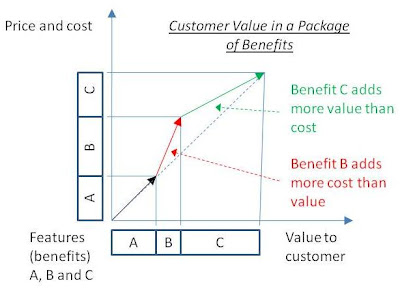
A customer buys a package of benefits when they buy your product or service
- Some of these benefits are more important than others to your customer – some they may not want or value at all, some are critical and some they may not even realise they get. This will be different for each customer
- Some of these benefits cost you more than others to provide – some cost you a lot and some are free – or may even reduce your costs
- If you understand the relative value and cost then this allows you to make adjustments to your product, pricing and proposition so that you optimise revenue and margin
o This is the basis of the low-cost airline model. The benefits that were removed were valued less by passengers than the price reduction made possible by re-designing the airline process
How can I use this in my small business?
- Make sure that you understand all the benefits included in your product or service and that they are highlighted in your proposition
- If appropriate, develop different services to incorporate different packages of benefits (gold, silver and bronze for instance)
- In individual cases, understanding relative costs and benefits will help you negotiate with the customer
o You can make sure that they are comparing like with like in terms of the complete benefits package by you and your competition
o You can discuss which benefits they are prepared to forgo if they are asking for a price reduction
o You can offer additional benefits that cost you little or nothing but which the customer values in order to close a deal
More business advice for business owners.
How do you value your business?
Want to see videos of my seminars for business owners?
- Some of these benefits are more important than others to your customer – some they may not want or value at all, some are critical and some they may not even realise they get. This will be different for each customer
- Some of these benefits cost you more than others to provide – some cost you a lot and some are free – or may even reduce your costs
- If you understand the relative value and cost then this allows you to make adjustments to your product, pricing and proposition so that you optimise revenue and margin
o This is the basis of the low-cost airline model. The benefits that were removed were valued less by passengers than the price reduction made possible by re-designing the airline process

How can I use this in my small business?
- Make sure that you understand all the benefits included in your product or service and that they are highlighted in your proposition
- If appropriate, develop different services to incorporate different packages of benefits (gold, silver and bronze for instance)
- In individual cases, understanding relative costs and benefits will help you negotiate with the customer
o You can make sure that they are comparing like with like in terms of the complete benefits package by you and your competition
o You can discuss which benefits they are prepared to forgo if they are asking for a price reduction
o You can offer additional benefits that cost you little or nothing but which the customer values in order to close a deal
More business advice for business owners.
How do you value your business?
Want to see videos of my seminars for business owners?
Monday, 19 July 2010
Why a business owner needs vision
Why have a Vision Statement?
- The purpose of creating a Vision Statement is to provide you, the business owner, with a clear picture of what you are going to achieve through owning your business
- One of the seven habits of effective leaders (as defined by Steven Covey) is that they always start with the end in mind. Even if your eventual exit from your business is many years away it will be worth far more and the exit process will be far easier if everything you do contributes to that exit
- If you do not have a clear vision how will you know which path to take or which decision to make? A clear vision will help you make those key decisions along the way
- The vision for your business will help you set short, mid and long-term objectives. When you set those objectives you should ask yourself how they contribute to achieving your vision
- The vision for your business will help you evaluate how you spend your time. Ask yourself frequently “How does this activity help me achieve my vision?” If it doesn’t, why are you doing it?
- It will help you communicate what is different and better about your business to staff and customers
What makes a good Vision Statement?
- It must be motivating for you. It must be something that you think is worth achieving and which matches your values and beliefs
- It should describe a particular point in time. This might be when you plan to exit or when you plan to achieve “success” as you see it. It should have a date
- It should describe what the business will be in concrete terms – how large, what it will be known for, what it will be able to do
- It should have a personal goal that describes how you will be spending your life. This might include your working life or your personal life or the options you would have by then
- It should have some concrete financial dimension – usually sale value, turnover or profit
- It should be written down
What do you do with your Vision Statement when you’ve got one?
- Use it to develop your internal and external Mission Statements which communicate to staff and customers what it is you do and why. (You wouldn’t normally share your Vision Statement directly with anyone else)
- Read it frequently. Use visioning or affirmations to picture yourself and your business at the point of the vision and look backwards at all the choices you made, the successes you had and the obstacles you overcame to get there – starting with the things you are doing today
- Use it to set your short, medium and long-term objectives and to validate your current strategy and decisions
More business advice for business owners.
How do you value your business?
Want to see videos of my seminars for business owners?
- The purpose of creating a Vision Statement is to provide you, the business owner, with a clear picture of what you are going to achieve through owning your business
- One of the seven habits of effective leaders (as defined by Steven Covey) is that they always start with the end in mind. Even if your eventual exit from your business is many years away it will be worth far more and the exit process will be far easier if everything you do contributes to that exit
- If you do not have a clear vision how will you know which path to take or which decision to make? A clear vision will help you make those key decisions along the way
- The vision for your business will help you set short, mid and long-term objectives. When you set those objectives you should ask yourself how they contribute to achieving your vision
- The vision for your business will help you evaluate how you spend your time. Ask yourself frequently “How does this activity help me achieve my vision?” If it doesn’t, why are you doing it?
- It will help you communicate what is different and better about your business to staff and customers
What makes a good Vision Statement?
- It must be motivating for you. It must be something that you think is worth achieving and which matches your values and beliefs
- It should describe a particular point in time. This might be when you plan to exit or when you plan to achieve “success” as you see it. It should have a date
- It should describe what the business will be in concrete terms – how large, what it will be known for, what it will be able to do
- It should have a personal goal that describes how you will be spending your life. This might include your working life or your personal life or the options you would have by then
- It should have some concrete financial dimension – usually sale value, turnover or profit
- It should be written down
What do you do with your Vision Statement when you’ve got one?
- Use it to develop your internal and external Mission Statements which communicate to staff and customers what it is you do and why. (You wouldn’t normally share your Vision Statement directly with anyone else)
- Read it frequently. Use visioning or affirmations to picture yourself and your business at the point of the vision and look backwards at all the choices you made, the successes you had and the obstacles you overcame to get there – starting with the things you are doing today
- Use it to set your short, medium and long-term objectives and to validate your current strategy and decisions
More business advice for business owners.
How do you value your business?
Want to see videos of my seminars for business owners?
Sunday, 2 May 2010
Recruitment interviews
Selecting people is just about the most important thing a business owner or manager does. It should not be left to chance – interviews should be planned.
Preparation
- Prepare or review the job description. This should describe the main tasks to be performed, the desired outputs or results and how this will be measured. It should list the technical knowledge or skills, level of experience and personal attributes required to be successful in the role.
- Prepare a marking scheme for candidates. This should list the requirements of the role and have spaces for positive evidence, negative evidence and a score against each.
- Prepare a structured interview. This is a series of questions designed to establish positive or negative evidence against each of the required attributes. These should be open questions which encourage the candidate to talk, rather than closed questions leading to a simple “Yes” or “No”. The questions should be layered so that you can drill down and get evidence of the previous experience or attitude if this is not volunteered.
- For certain roles you may need to deploy additional selection tests, such as role play, a presentation, psychometric tests or skills tests.
- Prepare a briefing pack for the candidates. This should include the job description, history of the organisation, organisation chart, any mission or value statements you have and so forth. Don’t forget that you are trying to sell the role to them and that good candidates will have a choice. Make sure that reception knows who to expect and how to welcome candidates.
The Interview
- Have more than one interviewer. The panel should include the person who will be the direct supervisor of the new employee and someone with good technical knowledge of the area concerned. Agree who will lead the interview.
- Set aside sufficient time (60-90 minutes) and make sure that there are no interruptions. There is nothing more important than hiring the right people.
- Make introductions and explain why people are there. Set the scene – company background, mission, values. Why the vacancy has arisen and key challenges/expectations for the role. Explain that you are following a structured process so that you will sometimes have to move the interview on.
- Follow the structured interview and stick to the time allowed. Listen actively to responses, encourage the candidate to open up but keep things focused and relevant. Cover all the questions and get evidence for all answers.
- Allow time for their questions at the end.
Post-interview
- Complete your notes and scoring immediately and compare with the other interviewers to reach a consensus.
- Take up all references and check all qualifications.
- Decide and appoint quickly – good candidates will have other options
Click here for more business advice
Preparation
- Prepare or review the job description. This should describe the main tasks to be performed, the desired outputs or results and how this will be measured. It should list the technical knowledge or skills, level of experience and personal attributes required to be successful in the role.
- Prepare a marking scheme for candidates. This should list the requirements of the role and have spaces for positive evidence, negative evidence and a score against each.
- Prepare a structured interview. This is a series of questions designed to establish positive or negative evidence against each of the required attributes. These should be open questions which encourage the candidate to talk, rather than closed questions leading to a simple “Yes” or “No”. The questions should be layered so that you can drill down and get evidence of the previous experience or attitude if this is not volunteered.
- For certain roles you may need to deploy additional selection tests, such as role play, a presentation, psychometric tests or skills tests.
- Prepare a briefing pack for the candidates. This should include the job description, history of the organisation, organisation chart, any mission or value statements you have and so forth. Don’t forget that you are trying to sell the role to them and that good candidates will have a choice. Make sure that reception knows who to expect and how to welcome candidates.
The Interview
- Have more than one interviewer. The panel should include the person who will be the direct supervisor of the new employee and someone with good technical knowledge of the area concerned. Agree who will lead the interview.
- Set aside sufficient time (60-90 minutes) and make sure that there are no interruptions. There is nothing more important than hiring the right people.
- Make introductions and explain why people are there. Set the scene – company background, mission, values. Why the vacancy has arisen and key challenges/expectations for the role. Explain that you are following a structured process so that you will sometimes have to move the interview on.
- Follow the structured interview and stick to the time allowed. Listen actively to responses, encourage the candidate to open up but keep things focused and relevant. Cover all the questions and get evidence for all answers.
- Allow time for their questions at the end.
Post-interview
- Complete your notes and scoring immediately and compare with the other interviewers to reach a consensus.
- Take up all references and check all qualifications.
- Decide and appoint quickly – good candidates will have other options
Click here for more business advice
Tuesday, 6 April 2010
How much is your business worth?
As a business owner, you should be starting with the end in mind, and the end must be maximizing the value of your business when you pass the reins on. Whatever your goals (and if you have them clear in your mind and written down you're in the minority), understanding how you make your business more valuable will be key to achieving them.
I'm not talking about selling up right now. In any case, unless you are an exceptional owner running an exceptional business, you need to aim off by at least three years to get things into a state where you can sell and get value. I'm not even talking about selling ever - you might want to hand it on to the next generation. I'm talking about understanding what increases the value of your business to others - and then managing those things. The reason is simple; the things that make your business valuable to someone else make it manageable, resilient, growing and profitable for you.
The factors you need to consider are not just financial (although those are pretty important, of course). You'll also need to understand and address the vision, market positioning, processes, quality of revenue - and your own role now and in the future.
If you are a business owner and you want to learn a bit more about these things then you might like to come along to this free seminar - you'll learn something and you'll get a free breakfast as well.
I'm not talking about selling up right now. In any case, unless you are an exceptional owner running an exceptional business, you need to aim off by at least three years to get things into a state where you can sell and get value. I'm not even talking about selling ever - you might want to hand it on to the next generation. I'm talking about understanding what increases the value of your business to others - and then managing those things. The reason is simple; the things that make your business valuable to someone else make it manageable, resilient, growing and profitable for you.
The factors you need to consider are not just financial (although those are pretty important, of course). You'll also need to understand and address the vision, market positioning, processes, quality of revenue - and your own role now and in the future.
If you are a business owner and you want to learn a bit more about these things then you might like to come along to this free seminar - you'll learn something and you'll get a free breakfast as well.
Subscribe to:
Posts (Atom)