Does every business decision have to be taken by you?
Are you unable to get away from the business for even a short time without things going wrong?
Ambitious business owners overcome many challenges to grow their business - but sometimes the biggest challenge is to make their business work without them. After the business reaches a certain point, owners find that their time, effort and knowledge is the main constraint on future growth.
They struggle to delegate anything meaningful to their staff, or develop their staff so tha they are ready for more responsibility.
This seminar "The Owners' Trap" will tell you how to break free of these constraints.
Learn how to raise your game by visiting my website.
Showing posts with label Business advice near Reading. Show all posts
Showing posts with label Business advice near Reading. Show all posts
Monday, 9 January 2012


Monday, 12 September 2011
Feeling the management strain?
As your business grows it doesn't just get bigger. It gets more complicated. More staff, Bigger, more demanding customers. More rules. Trying to manage through other people. Delegation.
You'd go mad trying to run it the way you used to run a small business - or give yourself a heart-attack. And you'd fail, and go back to being small.
There is an alternative. Learn how to manage a bigger business at this business advice seminar.
Or take a look at our business advice website.
You'd go mad trying to run it the way you used to run a small business - or give yourself a heart-attack. And you'd fail, and go back to being small.
There is an alternative. Learn how to manage a bigger business at this business advice seminar.
Or take a look at our business advice website.
Monday, 5 September 2011
Looking for investment?
Are you looking for a bank loan or business angel to fund your business growth plans?
Do you understand the kind of things they look for in a company before they will invest?
Do you know what government finance is (still) available and how you qualify?
These are big issues. Succeed or fail issues. Don't leave it to chance - talk to us.
As a first step, get yourself on this business advice seminar or take a look at our business advice website.
Do you understand the kind of things they look for in a company before they will invest?
Do you know what government finance is (still) available and how you qualify?
These are big issues. Succeed or fail issues. Don't leave it to chance - talk to us.
As a first step, get yourself on this business advice seminar or take a look at our business advice website.
Friday, 26 August 2011
8 ways to your unique proposition
Price
- This can be low price if you have a unique process or advantage that will always keep your costs below the competition’s. If not then competing solely on price is suicide
- This could be high price if you have a luxury product which is in demand by people who want to be seen as able to afford exclusivity
Speed- This can be fast (for example food or deliveries) as long as you have a process which always delivers faster than anyone else
- This could be slow (for example fine dining or whisky) as long as the wait is seen as part of the pay-off for the buyer.
Newness- In the technology or gadget market some people buy things simply because they are new. Some businesses compete on performance (for example computers or phones) so they need innovation from their suppliers
- Oldness can also be a selling point – think antiques, or retro, or reliability
Convenience- Petrol stations can charge more for essential items than supermarkets because they are next to the road and have parking. Convenience could also mean opening hours or home delivery or anything else that makes it easier for the customer
- Being a one-stop shop
Range- Both breadth of range and numbers stocked can be a powerful USP. If a customer is pushed for time or in a fix they look for the place that always has what they need on the shelf.
Expertise or specialism- The ultimate is to be seen as a specialist in a field of one. This is really what defining a niche is about; making yourself a specialist.
Quality and Service- Never the word “quality” or “service” but a deep understanding of what attributes represent quality and service in your market and a proposition which not only delivers on these but uses these terms to resonate with the customer.
ReliabilityMonday, 16 May 2011
Are you offering your customers too much?
A customer buys a package of benefits when they buy your product or service. Some of these benefits are more important than others to your customer – some they may not want or value at all, some are critical and some they may not even realise they get. This will be different for each customer.
Some of these benefits cost you more than others to provide – some cost you a lot and some are free – or may even reduce your costs. If you understand the relative value and cost then this allows you to make adjustments to your product, pricing and proposition so that you optimise revenue and margin. This is the basis of the low-cost airline model. The benefits that were removed were valued less by passengers than the price reduction made possible by re-designing the airline process.
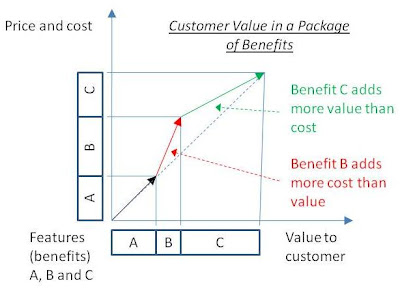
If you'd like to find how to apply this to your business then this event is for you.
More business advice for business owners.
Some of these benefits cost you more than others to provide – some cost you a lot and some are free – or may even reduce your costs. If you understand the relative value and cost then this allows you to make adjustments to your product, pricing and proposition so that you optimise revenue and margin. This is the basis of the low-cost airline model. The benefits that were removed were valued less by passengers than the price reduction made possible by re-designing the airline process.

If you'd like to find how to apply this to your business then this event is for you.
More business advice for business owners.
Monday, 2 May 2011
Are market forces tearing your business apart?
Michael Porter cam up with a great model - The Five Forces - to help think about markets. It was aimed at big businesses but is great for SMEs...
Find ways to reduce the bargaining power of customers. Reduce their choice of alternative suppliers by making your proposition unique or reduce their share of your total sales by selling more to other customers
Find ways to raise the barriers to new entrants. Build special knowledge or resources into your service and proposition. Develop and nurture relationships that are hard to replicate, for instance, local government preferred supplier status.
Use competitive intelligence to avoid being caught out by products or services that will replace your own
If you'd liek to find out how applying this model to your business could turbocharge growth then this event is for you.
See more great tips on our website.
Find ways to reduce the bargaining power of customers. Reduce their choice of alternative suppliers by making your proposition unique or reduce their share of your total sales by selling more to other customers
Find ways to raise the barriers to new entrants. Build special knowledge or resources into your service and proposition. Develop and nurture relationships that are hard to replicate, for instance, local government preferred supplier status.
Use competitive intelligence to avoid being caught out by products or services that will replace your own
If you'd liek to find out how applying this model to your business could turbocharge growth then this event is for you.
See more great tips on our website.
Monday, 11 April 2011
Do you really know who your customers are?
Do you define your market as, say, “consumers” or “SMEs"? Do you understand why such a definition is pretty useless?
You need to divide your market down further into particular types of customer, for example
o “Owner-managed businesses in the RG postcode with between 5 and 50 employees” or
o “Builders on the local council suppliers list who do not have an internal H&S manager” or
o “Women between 25 and 35 who are fashion-conscious but on a budget.”
- It helps to give them a name – for instance a supermarket chain might categorise some of its customers as “Northern Brand Loyalists” and others as “Sausage-and-mashers”
- A customer category is another way of describing a market niche
Why have customer categories?
- It will help you make decisions about which customers you want – and which you don’t want
o Which customers are more profitable – and which are a nightmare to deal with?
- It will help you understand why those customers choose your product or service – or that of your competitor
o Which benefits are more important to them – and which less?
o How well do you match those desires – and how do you compare with the competition?
- It will help you develop propositions which are tuned to the customers’ requirements – even if the base product or service is the same
- It will help you quickly and easily communicate the type of customer you are looking for
- You should strive to be number 1 or 2 in your market. If you are not big enough to achieve this in the whole market you can focus on a niche (a customer category) where you can be number 1 or 2 and so dominate.
If you'd like to know more about how understanding customers can drive your business growth then this event is for you
See more advice for business owners here
You need to divide your market down further into particular types of customer, for example
o “Owner-managed businesses in the RG postcode with between 5 and 50 employees” or
o “Builders on the local council suppliers list who do not have an internal H&S manager” or
o “Women between 25 and 35 who are fashion-conscious but on a budget.”
- It helps to give them a name – for instance a supermarket chain might categorise some of its customers as “Northern Brand Loyalists” and others as “Sausage-and-mashers”
- A customer category is another way of describing a market niche
Why have customer categories?
- It will help you make decisions about which customers you want – and which you don’t want
o Which customers are more profitable – and which are a nightmare to deal with?
- It will help you understand why those customers choose your product or service – or that of your competitor
o Which benefits are more important to them – and which less?
o How well do you match those desires – and how do you compare with the competition?
- It will help you develop propositions which are tuned to the customers’ requirements – even if the base product or service is the same
- It will help you quickly and easily communicate the type of customer you are looking for
- You should strive to be number 1 or 2 in your market. If you are not big enough to achieve this in the whole market you can focus on a niche (a customer category) where you can be number 1 or 2 and so dominate.
If you'd like to know more about how understanding customers can drive your business growth then this event is for you
See more advice for business owners here
Monday, 16 August 2010
Why qualifying sales will help sales grow
Why do you need to qualify sales leads?
- The process which takes a lead through to a sale (the conversion process) can consume a lot of resources, particularly for complex sales
- This process is much more productive (that is, has a higher conversion rate and uses less resource) if those leads which are likely to be low value and/or unlikely to result in a sale are screened out earlier in the process
- If the conversion process has very low marginal costs (eg an online shop) then the need for qualification is correspondingly lower
What factors can be used to qualify sales leads?
- The factors can vary widely according to the industry you are in but could include:
o Are you talking to the decision-maker and budget-holder?
o Are they in your target market and the right type and size of customer?
o Do they have the funds or budget to buy your product?
o Do they have the compelling need, commitment and motivation to buy now?
o Can you provide what they need without stretching your product, credibility or resources?
o Do you have all the necessary pre-qualifications (policies, accreditations, size and stability)?
o Is there an incumbent or preferred supplier who is almost certain to win the business?
How are leads qualified?
- Qualification should be part of your sales process
o It should also be built into your marketing
- It could take place at a single point or you could have several stages of qualification
- The criteria for qualification (taken, for example, from the above list) should be recorded against each lead in your sales management system
- The conversion process results (wins and losses) should feed back into the qualification process
o A low conversion rate may well indicate poor qualification
More business advice for business owners.
How do you value your business?
Want to see videos of my seminars for business owners?
- The process which takes a lead through to a sale (the conversion process) can consume a lot of resources, particularly for complex sales
- This process is much more productive (that is, has a higher conversion rate and uses less resource) if those leads which are likely to be low value and/or unlikely to result in a sale are screened out earlier in the process
- If the conversion process has very low marginal costs (eg an online shop) then the need for qualification is correspondingly lower
What factors can be used to qualify sales leads?
- The factors can vary widely according to the industry you are in but could include:
o Are you talking to the decision-maker and budget-holder?
o Are they in your target market and the right type and size of customer?
o Do they have the funds or budget to buy your product?
o Do they have the compelling need, commitment and motivation to buy now?
o Can you provide what they need without stretching your product, credibility or resources?
o Do you have all the necessary pre-qualifications (policies, accreditations, size and stability)?
o Is there an incumbent or preferred supplier who is almost certain to win the business?
How are leads qualified?
- Qualification should be part of your sales process
o It should also be built into your marketing
- It could take place at a single point or you could have several stages of qualification
- The criteria for qualification (taken, for example, from the above list) should be recorded against each lead in your sales management system
- The conversion process results (wins and losses) should feed back into the qualification process
o A low conversion rate may well indicate poor qualification
More business advice for business owners.
How do you value your business?
Want to see videos of my seminars for business owners?
Monday, 26 July 2010
Customer benefits and their costs
A customer buys a package of benefits when they buy your product or service
- Some of these benefits are more important than others to your customer – some they may not want or value at all, some are critical and some they may not even realise they get. This will be different for each customer
- Some of these benefits cost you more than others to provide – some cost you a lot and some are free – or may even reduce your costs
- If you understand the relative value and cost then this allows you to make adjustments to your product, pricing and proposition so that you optimise revenue and margin
o This is the basis of the low-cost airline model. The benefits that were removed were valued less by passengers than the price reduction made possible by re-designing the airline process
How can I use this in my small business?
- Make sure that you understand all the benefits included in your product or service and that they are highlighted in your proposition
- If appropriate, develop different services to incorporate different packages of benefits (gold, silver and bronze for instance)
- In individual cases, understanding relative costs and benefits will help you negotiate with the customer
o You can make sure that they are comparing like with like in terms of the complete benefits package by you and your competition
o You can discuss which benefits they are prepared to forgo if they are asking for a price reduction
o You can offer additional benefits that cost you little or nothing but which the customer values in order to close a deal
More business advice for business owners.
How do you value your business?
Want to see videos of my seminars for business owners?
- Some of these benefits are more important than others to your customer – some they may not want or value at all, some are critical and some they may not even realise they get. This will be different for each customer
- Some of these benefits cost you more than others to provide – some cost you a lot and some are free – or may even reduce your costs
- If you understand the relative value and cost then this allows you to make adjustments to your product, pricing and proposition so that you optimise revenue and margin
o This is the basis of the low-cost airline model. The benefits that were removed were valued less by passengers than the price reduction made possible by re-designing the airline process
How can I use this in my small business?
- Make sure that you understand all the benefits included in your product or service and that they are highlighted in your proposition
- If appropriate, develop different services to incorporate different packages of benefits (gold, silver and bronze for instance)
- In individual cases, understanding relative costs and benefits will help you negotiate with the customer
o You can make sure that they are comparing like with like in terms of the complete benefits package by you and your competition
o You can discuss which benefits they are prepared to forgo if they are asking for a price reduction
o You can offer additional benefits that cost you little or nothing but which the customer values in order to close a deal
More business advice for business owners.
How do you value your business?
Want to see videos of my seminars for business owners?
Monday, 19 July 2010
Why a business owner needs vision
Why have a Vision Statement?
- The purpose of creating a Vision Statement is to provide you, the business owner, with a clear picture of what you are going to achieve through owning your business
- One of the seven habits of effective leaders (as defined by Steven Covey) is that they always start with the end in mind. Even if your eventual exit from your business is many years away it will be worth far more and the exit process will be far easier if everything you do contributes to that exit
- If you do not have a clear vision how will you know which path to take or which decision to make? A clear vision will help you make those key decisions along the way
- The vision for your business will help you set short, mid and long-term objectives. When you set those objectives you should ask yourself how they contribute to achieving your vision
- The vision for your business will help you evaluate how you spend your time. Ask yourself frequently “How does this activity help me achieve my vision?” If it doesn’t, why are you doing it?
- It will help you communicate what is different and better about your business to staff and customers
What makes a good Vision Statement?
- It must be motivating for you. It must be something that you think is worth achieving and which matches your values and beliefs
- It should describe a particular point in time. This might be when you plan to exit or when you plan to achieve “success” as you see it. It should have a date
- It should describe what the business will be in concrete terms – how large, what it will be known for, what it will be able to do
- It should have a personal goal that describes how you will be spending your life. This might include your working life or your personal life or the options you would have by then
- It should have some concrete financial dimension – usually sale value, turnover or profit
- It should be written down
What do you do with your Vision Statement when you’ve got one?
- Use it to develop your internal and external Mission Statements which communicate to staff and customers what it is you do and why. (You wouldn’t normally share your Vision Statement directly with anyone else)
- Read it frequently. Use visioning or affirmations to picture yourself and your business at the point of the vision and look backwards at all the choices you made, the successes you had and the obstacles you overcame to get there – starting with the things you are doing today
- Use it to set your short, medium and long-term objectives and to validate your current strategy and decisions
More business advice for business owners.
How do you value your business?
Want to see videos of my seminars for business owners?
- The purpose of creating a Vision Statement is to provide you, the business owner, with a clear picture of what you are going to achieve through owning your business
- One of the seven habits of effective leaders (as defined by Steven Covey) is that they always start with the end in mind. Even if your eventual exit from your business is many years away it will be worth far more and the exit process will be far easier if everything you do contributes to that exit
- If you do not have a clear vision how will you know which path to take or which decision to make? A clear vision will help you make those key decisions along the way
- The vision for your business will help you set short, mid and long-term objectives. When you set those objectives you should ask yourself how they contribute to achieving your vision
- The vision for your business will help you evaluate how you spend your time. Ask yourself frequently “How does this activity help me achieve my vision?” If it doesn’t, why are you doing it?
- It will help you communicate what is different and better about your business to staff and customers
What makes a good Vision Statement?
- It must be motivating for you. It must be something that you think is worth achieving and which matches your values and beliefs
- It should describe a particular point in time. This might be when you plan to exit or when you plan to achieve “success” as you see it. It should have a date
- It should describe what the business will be in concrete terms – how large, what it will be known for, what it will be able to do
- It should have a personal goal that describes how you will be spending your life. This might include your working life or your personal life or the options you would have by then
- It should have some concrete financial dimension – usually sale value, turnover or profit
- It should be written down
What do you do with your Vision Statement when you’ve got one?
- Use it to develop your internal and external Mission Statements which communicate to staff and customers what it is you do and why. (You wouldn’t normally share your Vision Statement directly with anyone else)
- Read it frequently. Use visioning or affirmations to picture yourself and your business at the point of the vision and look backwards at all the choices you made, the successes you had and the obstacles you overcame to get there – starting with the things you are doing today
- Use it to set your short, medium and long-term objectives and to validate your current strategy and decisions
More business advice for business owners.
How do you value your business?
Want to see videos of my seminars for business owners?
Subscribe to:
Posts (Atom)